This Ted talk is fascinating. Think about what happens to things over their entire lifetime. Landfill in general is bad for the environment, even if what is being dumped is biodegradable as an anaerobic (airless) environment produces methane and not carbon dioxide. Watch this talk and start to see how complex solutions need to be, since the problems are complex.
Thursday, February 13, 2014


Sunday, November 17, 2013
Melbourne climate change rally speech on Christian faith & climate change
As
a Christian thinker and a climate scientist, I don’t want to talk this morning
just of facts and figures, but imagination and dreams. I dream of
a world of peace and justice, where resources are shared fairly, and where the
Earth is treasured and protected.
Climate
change is not just about science, technology or politics, although we need good
science, green technologies and strong vision and leadership. Climate change is
a deeply moral issue, and as we face an uncertain future, every
person needs to be able to dream; to imagine a different world, a different way
of pursuing the good life.
My
dream of a better world is shaped by the Christian story of a God who loves,
creates, redeems and renews. The cross of Jesus is the greatest expression of
God’s love, and in response I am compelled to love God, and love my neighbour.
To
love God means that I must love the world he has made. If the world
warms by 2 degrees, more than 99% of all coral reefs will disappear; amazingly
rich and beautiful ecosystems that are thousands of years old. Because I
believe in a creator, this world is not disposable but sacred. The
destruction we risk is not only wanton, but blasphemous.
In
a world where I wear clothes made in Bangladesh, watch American movies
on a Korean TV, and when I drive my Japanese car I add gases that warm the
whole planet, everyone is my neighbour. In the parable of the Good
Samaritan, Jesus told a story about a man attacked by robbers, to teach us that
we are to love our neighbours when they are in need.
This
story of Jesus calls me to be a Good Samaritan and bind the wounds of those who
suffer, and right now, people are suffering from climate change; from
sea level rise, heat waves, bushfire and more violent storms.
But
more than this, if we fail to act now to limit future climate change, we
are not just being bad neighbours; we are robbers, stealing from our
neighbours and future generations the chance to live full and meaningful lives.
So,
today, I implore to think about what inspires you to dream of a better
world, and act on climate change
Let’s
dream together to protect this world we all call home, and together live
as neighbours.
God
bless you.
Wednesday, November 13, 2013
Praying for rain and protesting on climate change
With the 12 hottest months on record in Australia and 3 driest months in Sydney it is little surprise that bushfires have been an issue. So from a Christian perspective, praying for rain is a natural reaction. I saw a picture on Facebook of some dry parkland grass, and a comment that the photographer was praying for rain. While I agree - I did want to say, will you be at the climate change rally?
It seems to me that some conservative Christians seem blind to the way things work, or the way God chooses to exercise sovereignty in the climate system. I remember my wife saying she used to pray as a child for a white Christmas, in Tamworth NSW! While I am sure the God who raised Jesus from the dead could make it snow in an Australian summer, I'm not sure why he would. So when people pray for rain in the midst of a neutral ENSO event (average rainfall expected) but in a world we've obviously changed through our own actions, how do they expect the prayer to be answered?
Prayer is an act of utter dependence on God, and yet I see nothing in Scripture that says we don't do anything to work towards those prayers in all situations. Yes there are times when we can do nothing, but with climate change there is plenty we can do.
It is time to regard church as not simply doing the same thing every Sunday as if we were somehow chained to a Sunday morning service inside of four walls. It's missionally ignorant, and given the gravity of climate change it is morally indefensible.
I have the great honour of addressing the Melbourne rally as a person of faith on why I am passionate about climate change. It is a brief window of opportunity to show the breadth and depth of the gospel, the good news that God is putting everything right through Jesus. So, I may be preaching to the converted here, but this Sunday is a time to do church outside, along side others of many faiths or none. I'll put the text of my speech up Sunday night.
It seems to me that some conservative Christians seem blind to the way things work, or the way God chooses to exercise sovereignty in the climate system. I remember my wife saying she used to pray as a child for a white Christmas, in Tamworth NSW! While I am sure the God who raised Jesus from the dead could make it snow in an Australian summer, I'm not sure why he would. So when people pray for rain in the midst of a neutral ENSO event (average rainfall expected) but in a world we've obviously changed through our own actions, how do they expect the prayer to be answered?
Prayer is an act of utter dependence on God, and yet I see nothing in Scripture that says we don't do anything to work towards those prayers in all situations. Yes there are times when we can do nothing, but with climate change there is plenty we can do.
It is time to regard church as not simply doing the same thing every Sunday as if we were somehow chained to a Sunday morning service inside of four walls. It's missionally ignorant, and given the gravity of climate change it is morally indefensible.
I have the great honour of addressing the Melbourne rally as a person of faith on why I am passionate about climate change. It is a brief window of opportunity to show the breadth and depth of the gospel, the good news that God is putting everything right through Jesus. So, I may be preaching to the converted here, but this Sunday is a time to do church outside, along side others of many faiths or none. I'll put the text of my speech up Sunday night.
Tuesday, November 5, 2013
Friday, September 20, 2013
Ice, ice baby - Arctic sea ice and climate change
One
of the clear signs that someone has an agenda is when they cherry pick the
data. It’s a common mistake to focus too much on the short term at the expense
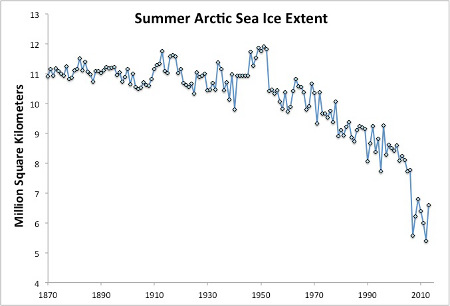
of the longer view. A recent example of this is the cover of Arctic Sea
ice. Skeptics are claiming that sea ice has undergone a recent recovery, and
therefore, along with the apparent stalling of global warming as measured by
atmospheric temperatures, climate change is a myth. This is simply not true.
Arctic
sea ice loss has been steadily occurring for some time. Satellite observations
show it has been in decline since 1979 when observations first began.
Observations from the Danish Meteorological Institute and Norwegian Polar
Institute and ocean vessels have shown sea-ice cover is much lower than it has
been since 1870. Studies of older climate from tree rings, ice cores and lake
sediments can take us back even further, showing sea-ice is at its lowest for
over 1400 years.
Perhaps
the best way to think about sea ice loss is to compare blocks of cheddar cheese
to cheese slices. If you want to cut a slice off a slice of cheddar, you cut it
length ways, with each slice of equal thickness. With each slice you cut off,
the surface area of cheese decreases. Compare that to cheese slices. Each time
you remove a slice, the surface area remains the same but the thickness of the
cheese decreases.
The
melting of sea ice is like the removal of cheese slices, except sea ice varies
in thickness. The thickness of ice reflects its age, with the thinnest ice
being last season’s freezing and the thickest being from multiple years of
freezing. Each summer, sea ice thins due to warming temperatures. Consider a
distribution of sea ice where 25% is less than one metre. If during a summer
season, there is a total of one metre of thinning, then there will be a 25%
reduction in total sea ice. If that distribution changes over time such that
50% has a thickness of one metre, then the same summer time melting reduces the
area but 50% instead of 25%.
This
is what has been observed over time, sea ice has thinned, or another way of
describing it is that total ice volume has decreased, due to warming air and
ocean temperatures. Over shorter timescales, individual weather events can
dramatically affect the total surface area of ice as thin ice can rapidly grow.
For example, in 2012, a low pressure system spent nearly two weeks churning up
ice already thin from a warm start to the season resulted in the lowest sea ice
cover on record, though scientists think the ice would have reached a record
low anyway. This year’s so-called recovery simply means that low pressure
systems have brought snow fall and not damaged the ice, resulting in the 6th
lowest sea ice cover on record.

Image from Skeptical Science shows so called recovery is simply a growth in area due to seasonal differences.

The
moral of this story is that various key indicators of climate change do vary
naturally on short time scales, be it year to year or over a few decades. This
does nothing to change the longer term trends due to the burning of fossil
fuels, land clearing and other drivers of climate change.
Further
reading
http://www.skepticalscience.com/arctic-sea-ice-recovers-to-6th-lowest-extent-in-millennia.html
is at a popular level and contains references
http://www.washington.edu/news/2013/01/31/cyclone-did-not-cause-2012-record-low-for-arctic-sea-ice/
discusses the 2012 record low and the role the Great Arctic Cyclone
played
http://www.pnas.org/content/106/49/20590.abstract?sid=78edbb84-7202-4498-9e02-bd52e449ac7f
discusses the idea of tipping points and illustrates how sea ice varies from
year to year. Moderately technical.
Monday, September 16, 2013
Making peace with lions
This short video from Ted is inspiring, that solutions for living alongside wildlife in an ever compressed world don't need to be hightech. All we need to do is think creatively so that we all might live in harmony. Now if only solving global warming were so simple....
Friday, September 13, 2013
Why top predators are essential to ecosystems
Talk by George Monbiot on his new book Feral on rewilding ecosystems. Book review to follow (when it arrives in the mail and I read it).
Subscribe to:
Posts (Atom)