Monday, May 18, 2015

Creation care at Kyneton - a Friends of A Rocha Australia trip

The author in a dry creek bed.
On May 16, a small groups of people set off from Melbourne to join some Kyneton locals to look at some 11,000 hectares of a mixture of degraded grazing land and remnant trees and native grasses. This was part of Friends of A Rocha Australia, a volunteer group of Christians trying to establish A Rocha in Australia.

Gorse bush. As prickly as it looks
I've been involved in getting this happening for the better part of a decade, so it was a relief, very exciting and very surreal to finally go out and do some work. For the ten or so of us, there wasn't as much work as we had originally though. One group stretched out some fencing, while some of us got to walk along the gorge and cut down and paint with herbicide some gorse bush. Very prickly, very sharp and a bit of an effort.


In the end, we spent a couple of hours surveying the property, and then sat down for lunch. Tick three of the A Rocha Cs - Christianty, Conservation and Community (which often happens over Cuisine!)

The afternoon consisted of a reflection on Psalm 104, with a local version of verses 5-25 (separate post to follow). Much discussion ensued about theology: orthodoxy (right theology), orthopraxis (right doing), community, traditional versus worship outside, and future developments onsite. Plans are to return October 31 for more work, reflection, etc. If interested, contact me via Friends of A Rocha Australia.


Remnants from Black Saturday bushfire


Wednesday, April 29, 2015

Denial 101x

While I'm meant to be blogging through Forest Church, I've been distracted by a few things. The first is a book chapter I have to finish on eco-theodicy and eco-eschatology (more on this in another post). But I also want to recommend a MOOC (Massive open online course) through Edx, entitled Denial 101x.

This course is run through the MOOC site Edx from the University of Queensland and includes John Cook of Skeptical Science, a well run blog that counters climate science myths from denialists. It will look at the psychology of denial as well as countering common denialist arguments. Well worth a look. I've started it today.

Friday, April 17, 2015

Inside out worship with Forest Church


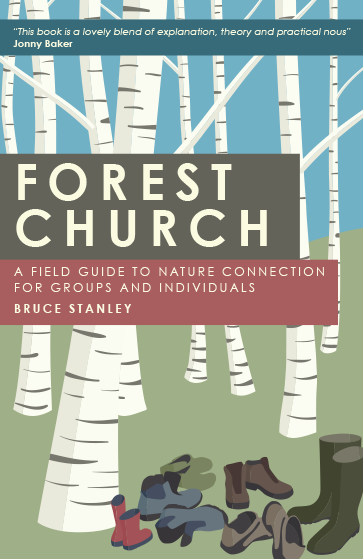
I've started to read the US edition of this book, contemplating how I might start a Forest Church locally. One of the things that Bruce Stanley notes in chapter 1 is how we've shut up worship inside. Nature is associated with thin places, places where we meet the transcendent. These can also be called liminal spaces.

Of course, this is a book on experiencing the divine in nature, but straight away some might wonder about special revelation and how this can happen anywhere. While I fully support the idea of the reenchantment of nature (well of creation), the first few pages risk slipping into primitivism.

Perhaps gathering is more efficient than agriculture (I can't verify this), but gathering won't support anything like our global population - so is the account an historical account of agriculture or a thinly veiled critique? Likewise, it's unhelpful to picture indigenous North Americans or Australians purely as gatherers, presumably to set this up as the ideal, embedded in nature, simply because it isn't true. Get your facts straight by trying to see beyond your ideology; helpful corrective or not.

Gathering might in general be more robust to climate shocks, but it is natural change that forced or helped humans into agriculture. We may have moved through a period of poor nutrition in that shift - but it will be all the poorer if we went back. What I'm saying is that there is a difference between societal progress and spiritual progress. If a return to our place in nature is what is needed spiritually as well as for our physical survival, it can't, won't and should be the same as making an entirely physical return, unless we all want to be entirely open to the elements and predators. There is safety behind doors that is entirely desirable. 

It might be true too that a view of God changes from a gather's milieu to a farmer's one. But that doesn't mean viewing nature purely as enemy, as much as our crops etc need protecting from it. The Israelites saw this in two ways. Firstly, the valuing of wilderness as special to God (Psalm 104). Secondly, the Sabbath rest for land (agricultural) and the allowing of wild animals to benefit from that (wildnerness).

What I'm saying is that making sacred spaces and finding them in nature are not opposed. It's just that the later is profoundly neglected in many Christian circles. Genesis 1 tells us all space is sacred. Working that out in different contexts will form part of working out what Forest Church will mean here in Melbourne.


Thursday, April 16, 2015

A climate of hope on air

Ok so I've been slack but have lots to write shortly. Working on a book chapter contribution (more on this soon), but for the moment lots of promoting my book A Climate of Hope with Claire Dawson. last night we were on Ecofaith on the air with Jason John and Miriam Pepper. I think we're slowly settling into the program, which is set as being a panel on the first and third Wednesday of the month.

Apparently half the show wasn't recorded :( but what does exist is found here.

We also launched our book officially at the Surrender conference. I got to talk a bit about the book on Sunday Nights with John Cleary, audio here.

Here's a wonderful pic from the launch.

On the left is Sharmila, who interviewed us here but who also wrote a conclusion for us. Next is the amazing Jarrod McKenna, peace activitist, Jesus justice junkie and all round good guy who wrote the intro. Then there's Claire and myself and finally Gabriel from UNOH who proof read the book, made some important comments and has made a lot of things happen. Sadly Les who did the layout and is working on the e-book didn't make the photo.

Claire and I will be at the Justice conference this weekend, sadly not speaking, but will hopefully have a few books on hand if you are there and want a copy.


Thursday, April 2, 2015

Ecofaith on the air

My friend Jason John and Miriam Pepper have started a new local radio program once a fortnight on 2BBB called Ecofaith on the air. It's a 1 hour time slot where a panel discusses the interaction between faith and ecology. I was on the first program last night with Jason, Miriam Pepper from National Church Life Survey (NCLS) and Jacqui Remond from Catholic Earth Care.

The frequency is 93.3 FM on the Mid North Coast of New South Wales, live streaming on 2bbb.net.au, and podcast on soundcloud at https://soundcloud.com/ecofaith-ontheair. There is also a Facebook page and a webpage http://ecofaith.org/.

On the 15th of April, Claire Dawson and I will be on discussing our book A Climate of Hope: Church and Mission in a warming world, see aclimateofhope.com

Monday, March 30, 2015

Murderous beginnings to the anthropocene

While I planned my latest post to be about the book launch of A Climate of Hope: Church and Mission in a Warming World at the Surrender conference, I've just been reading a paper from the journal Nature about the anthropocene, the idea that humans have so modified the planet that we should be speaking about a new geological age.

The article entitled Defining the Anthropocene by Simon Lewis and Mark Maslin examines a variety of possible definitions. Bill Ruddiman developed his Early Anthropocene Theory to suggest that the origin of modern agriculture has helped control greenhouse gas concentrations. For example, the onset of rice agriculture has meant more regions where methanogenic archaea (a primitive form of bacteria though of a different branch of life altogether) could thrive and increase atmospheric methane.

Ruddiman also suggested that plagues could result in a dip in CO2 concentrations when population reduction led to farmland reverting to forest. One of the rather sobering ideas in Lewis and Maslin's work is that the arrival of Europeans in the Americas saw a drop from about 61 million in 1492 to 6 million by 1650; the result of diseases, war, famine and enslavement. From ice core studies, a drop of 7-10 ppm in CO2 concentrationswas observed about 1610. This was a cool period during the Little Ice Age, a largely Northern Hemisphere phenomena.

It's a sober reminder that human hubris, violence and ignorance damage both human flourishing and that of the planet, and that all of our theorising in theology and the social sciences (as well as natural sciences?) need to be firmly post-colonial.

Even if 1610 isn't the best candidate for the beginnings of the anthropocene, it still marks a significant change in the state of affairs of the Earth.

Wednesday, March 18, 2015

Meanderings of a budding ecotheologian

I've taken to calling myself an ecotheologian because I've been thinking in this space for a while. Drawn in over a decade ago by being asked to write a paper (unrefereed) on climate change (I have a PhD in meteorology and teach a subject on climate change and natural variability), I've been thinking about climate change specifically and more generally about human/non-human creation relationships.

From the standpoint of the field, I'm very much an amateur, and pragmatics is the reason why I haven't started a Masters in Theology yet - this is to happen within the next couple of years - but I've plenty to do in the mean time with a second book slowly bubbling, a couple of contributed chapters and a few papers to write up.

Recently, an established academic Anne Elvey described me to someone as a budding ecotheologian. It's funny to think of oneself as budding at 45, but I like the phrase for a couple of reasons. Firstly, I like a good pun, and secondly it picks up on the fact that there is a process (one could argue a life long one) of becoming someone in the field. The growth has begun, but there is a flowering that is yet to come. Time to get growing.

I was able to give a couple of papers in the last week, firstly at the Conference on Science and Christianity (COSAC) run by ISCAST, I gave a paper on geoengineering. I think there are 2-3 potential papers in what I said. COSACs are always good - lots of diverse papers and thoughts, and the Geelong Conference Centre is a wonderful venue in the middle of the botanical gardens.

The other conference was the Graeme Clark Research Institute conference on rediscovering the spiritual in creation. An amazing lineup of Australian and international ecotheologians at the Serafino winery in McClaren Vale south of Adelaide. Much to follow up on. There, I presented my published work on a theology of wilderness. A few ideas to chase up from that as well.

This weekend are Surrender I'm giving a workshop on putting the Earth right and launching my book with Claire Dawson, A Climate of Hope. Keeping busy.